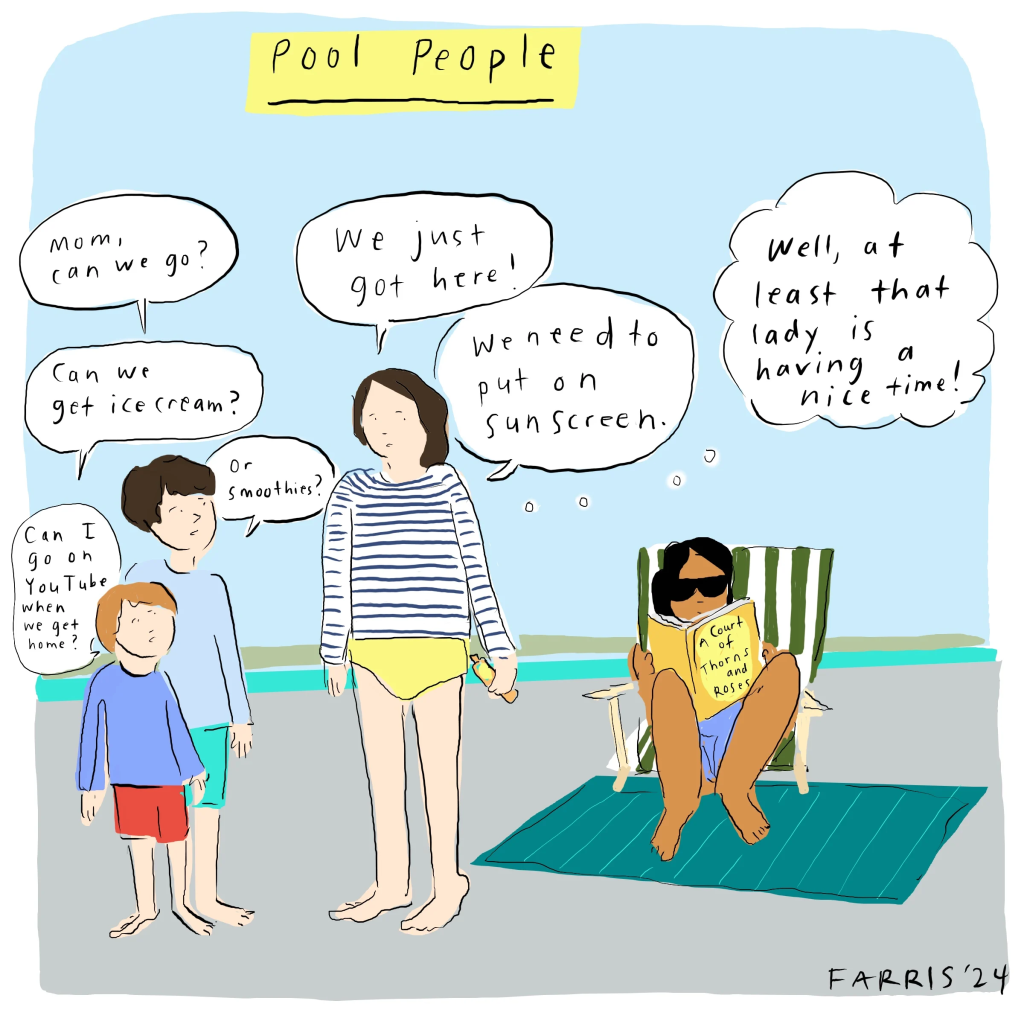
Pool People
Do you have clothes you’ve worn a million times? Mine include this shirt and these flats. So easy and comfy. (Here’s a steal version of the shoes.)
Status shows up whenever humans do, and it is the invisible underpinning of our culture.
The front lawn was only invented around the time of Columbus. The idea was to demonstrate that you had time and money to waste. You could take useful land and make it non-productive. You could take labor and put it to work taking care of this non-productive land with no obvious utility in return. A big front lawn, well cared for, was a sign of status and luxury.
It’s a contagious idea, and a sticky one. Many suburbs have it written into their laws.
John Green reminds us that Jay Gatsby paid to have a neighbor’s yard groomed before Daisy came over to meet him…
Weary parents shouldn’t miss this science-backed guide to raising kids
Most parenting manuals end up gathering dust on my bedside table, but Melinda Wenner Moyer’s Hello, Cruel World! isn’t one of them.

Hello, Cruel World!
The unfortunate thing about parenting books is that, in my experience, once you become a parent you are too time-poor and exhausted to read them. As a result, my bedside table is stacked with parenting manuals of which I’ve read the first five pages a dozen times before passing out. If this sounds like you, the latest book by science journalist Melinda Wenner Moyer should be top of your pile.
How to boost your brain power just by changing how you breathe
We mostly breathe subconsciously, but columnist Helen Thomson finds evidence that the brain functions differently when inhaling or exhaling, or breathing through your nose or mouth.

When my kids get nervous or are having a meltdown, I instinctively tell them to take a deep breath. It’s a reflex that I know innately feels good during a moment of panic or before a big presentation. But new evidence suggests breathing does more than just oxygenate the body – it fundamentally changes our brain, decreasing anxiety, sharpening our senses and enhancing our ability to perform. Those breakthroughs have left me wondering: could I improve my day, just by using my breath better?
Outdoor Gym
These are all valid! But it’s very important to be clear about which one you’re using. Because here’s something that happens a lot.


Be honest about why you reject weird ideas
There are lots of reasons you might do this.
- Pure prior: The idea sounds stupid and you haven’t looked at the argument.
- You’ve looked at the argument, but you think it’s wrong.
- You looked at the argument, but then realized you don’t have the background to understand it, so you went back to your prior.
- You looked at the argument, you do understand it, and it looks pretty good. But your prior is so strong you still reject the idea anyway.
- You looked at the argument, you understand it, it seems strong, and on an intellectual level, it overcomes your prior. But somehow you just aren’t able to get emotionally invested in the conclusion. (Sometimes I feel this way about AI risk.)